

There is this phrase people casually throw around “Just go with the flow.”
But have you ever thought about what this actually means? Seems like it can be interpreted however you want depending on the situation.
For some people it’s just not giving a shit. Others associate it with apathy and lack of ambition. Because of that people often throw this advice aside or even actively oppose it – in both cases missing the actual meaning. Along with what they can learn from it.
But when did we even get this idea of going with the flow?
While the exact source of the phrase isn’t known, I would argue that we should attribute it to Taoism. This eastern philosophy encouraged concepts like following the current and the natural flow of things much earlier than anything we see in western sources.
It also happens to be full of lessons that’ve been very useful in my daily life. You could say it’s the philosophy closest to my heart.
What is Taoism?
For most people their understanding of Taoism ends on “just go with the flow”.
To understand what this phrase is about you first need to understand: what does Taoism even mean?
Taoism is a Chinese philosophy that appeared around 450 – 300 BCE. Around that time two fundamental texts were produced: the Tao Te Ching and Zhuangzi. The philosophy itself preaches living in accordance with the Tao – an underlying indescribable truth of how the world operates. Because it’s a very ethereal concept – it’s supposed to be indescribable by its very nature – for the purposes of this essay think of it as “The Flow of the Universe”.
This is where we get to the principle of “flow” and one of the core virtues of Taoism – effortless action (wu-wei). But let’s first discuss where people stray from this idea.

What people get wrong about “going with the flow”?
In America, this phrase exploded in the 1960s. But unfortunately it seems to have spread without the underlying Taoistic principles.
People use it to shrink from difficult decisions – choosing to “go with the flow” and ignore the consequences.
In other scenarios it can just mean being “chilled out” and not worrying. And the Cambridge Online Dictionary interprets it in yet another way.
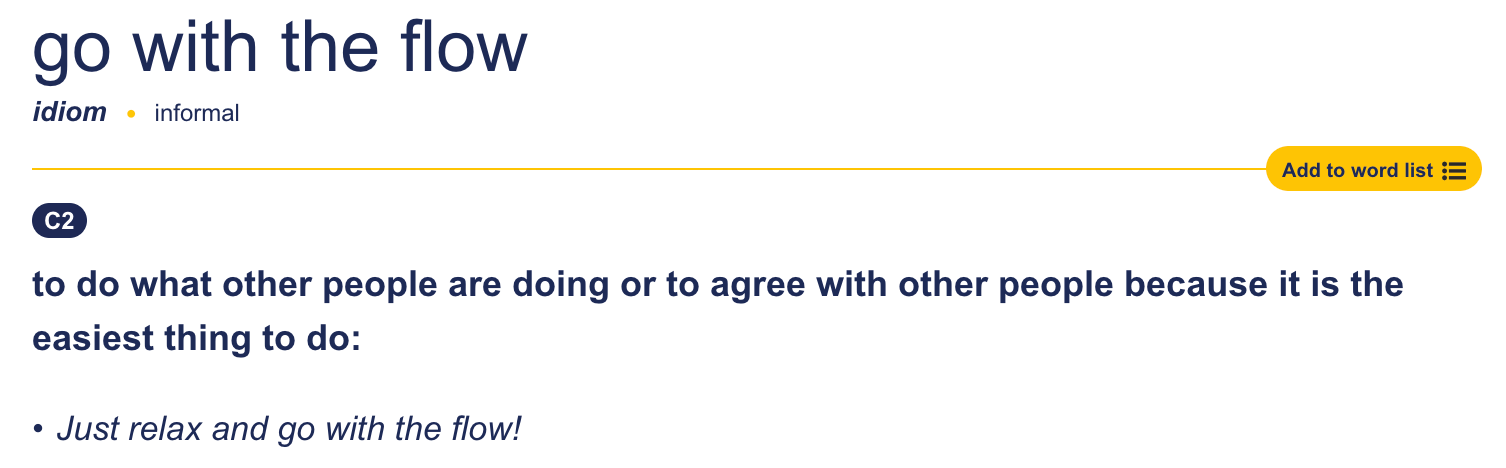
I never knew it’s possible to disagree with a dictionary definition but this time I definitely do.
The closest we got to the phrase’s Taoistic roots is by using it when we’re calmly circumventing unforeseen obstacles – often figuring out the best solution along the way.
But enough of that. You probably want to know by now: What is it that all of these approaches are missing?
Effortless action
In the space between obsessively putting in the effort and not doing anything at all, exists effortless action, also known as wu-wei.
The state where things come to you easily, where the goal stops mattering, and you can be both relaxed and active.
It’s like teaching someone to split wood and telling them “don’t go against the grain”. It doesn’t mean you should put down the axe – just use it in a way that’s in line with how it works the best. Don’t force it – follow the natural way of things. That’s how you “go with the flow”.

This quote by Lao Tzu explains this approach by comparing it to water. This point of being fluid but unyielding is worth emphasizing. In other words, be adaptable.
Don’t stubbornly attach yourself to goals and achievements. Focus on moving in the right direction instead. You already know what is currently helpful and what is harmful to you.
Work on removing the obstacles and you will naturally go in the right direction.
Taoists believe that the world governs itself and that forcefully bending it to your will is both impossible and will result in terrible consequences.
But that doesn’t mean being aimless. Just be adaptable and flow around the obstacles – patiently but not forcefully.
So how does it look like in practice?

Taoism in practice
The principle of effortless action (and Eastern philosophy in general) has been very helpful in my life.
I used to get obsessed with my goals. Whenever there was something I wanted to achieve; I always ended up fixating on it so much that it was everything I could think about.
Since forever I wanted to build a successful business. But by obsessing over the dream outcome – the nice apartment, money to travel and yada yada… I was only adding on more stress.
The core problem?
I was rigid and stubborn. I had a very narrow view of what I wanted to achieve and I couldn’t accept any other outcome. As a result I was constantly frustrated and obsessing over every single detail.
Is the landing page looking perfect? Did I write the email most likely to get a response? How quickly do I need to achieve my milestones to stick to my (imaginary) timeline?
All of that was happening while I was going through a difficult time in my life. Trying to finish college, find a job as a graphic designer, figure out what I want to do with my life, and find a way to move out of my parent’s house. All while going through some other personal struggles.
And bashing my head against the wall wasn’t working.
Since I was desperately trying do figure out some way to get out of this difficult spot, I was constantly searching for new answers – and eventually I had to open myself up to other possibilities. Becoming more adaptable.
I gave up my personal projects for a while. Started applying to other positions instead of graphic design jobs. Eventually I ended up getting 3 offers and actually taking the lowest-paid one.
Why did I do that?
I had a feeling it would open up some interesting possibilities in the future. I wasn’t sure what they would be, but I knew it’s worth trying out. I was finally becoming adaptable and noticing opportunities outside my preconceived path.
After that life started straightening out. I moved out to a small 24 m² apartment. But now I was appreciating it instead of fixating over my dream living space.
I was going to work every day but I was thankful for the people I met and the opportunities I got.
And I even started working on some side projects again, and when my unhealthy fixations started to resurface I recognized them for what they were and started working on them.
Now, I’m writing this essay and recording my YouTube videos, well aware that my goals if ever achieved are years into the future. And I know that before I reach them they’re likely to become something entirely different.
But I’m appreciating the growth this brings me. The books I’ve uncovered. The fluency in English I achieved. And most importantly – creating something I believe to be of value to the world.
And if anything about that changes I hope to stay adaptable, like water, acting in accordance with opportunities that present themselves – letting go of attachment, doubt and anxieties that impede my flow.
Thanks for reading,
Luke from Unwritten Tomes
P.S. I read, discuss essays and post additional content on my YouTube channel.
🎥 Follow me there to see if I posted anything new! (video about today’s topic drops tomorrow)